Detached Eyelid Muscle After Double Eyelid Surgery: Causes, Signs, and How to Manage It
Thanh Tam
Asked: 05/03/2026
Doctor, my name is Thanh Tâm. I had double eyelid surgery about 6 months ago, but recently my right eyelid has shown signs of drooping and no longer looks even like it did initially. I heard that this might be due to a “detached levator muscle.” I’m not sure why this condition occurs—whether it is due to the surgical technique or my own anatomy. If it is truly a detached muscle after eyelid surgery, what are the signs to recognize it, and would I need another surgery to correct it?
Hello, the doctor understands the concern when after double eyelid surgery the eyelids do not appear as beautiful as expected, especially when signs of detached eyelid muscle after double eyelid surgery appear — a relatively rare complication but one that can occur if the surgical technique is not performed accurately. In this article, the doctor will clearly explain the causes, recognition signs, and the proper management so that you can better understand and feel more reassured.
Causes of Detached Muscle After Double Eyelid Surgery
First, the doctor would like to confirm that detached eyelid muscle after double eyelid surgery refers to a condition where the eyelid fold after surgery cannot maintain its original crease, which may droop or become uneven between the two sides. The primary causes are related to surgical technique during the procedure and the anatomical characteristics of each person’s eyelid muscles and tissues.
From a professional standpoint, during double eyelid surgery the doctor will dissect, reshape the eyelid crease, and connect the levator muscle to the upper eyelid skin to create a stable eyelid fold. If the suturing that anchors the levator muscle is placed incorrectly or the anchoring force is too weak, or if the suture does not properly grasp the levator muscle layer, over time the muscle may “detach” from the anchoring point, causing the eyelid crease to disappear or the eyelid to droop.
In addition to surgical technique, several other factors may also contribute to muscle detachment such as:
Incorrect suturing technique may lead to eyelid detachment or drooping
The surgeon performs the manipulation too deeply, causing damage to the levator muscle.
Weak tissue anatomy or thick eyelid skin that prevents the sutures from anchoring firmly.
Improper postoperative care (for example: rubbing the eyes strongly, early eye movement, or wound infection).
In particular, if the surgery is performed at a facility without an eye plastic surgery specialist or without modern technologies such as Plasma scalpel or endoscopic microsurgical double eyelid technique, the risk of muscle detachment is higher because the incision may lack precision and the depth of tissue manipulation is harder to control.
Signs of Detached Muscle After Double Eyelid Surgery
After double eyelid surgery, if you notice that the eyelid fold does not remain clearly defined or that both eyelids appear noticeably uneven, it may be a warning sign of detached eyelid muscle after double eyelid surgery. Common signs include:
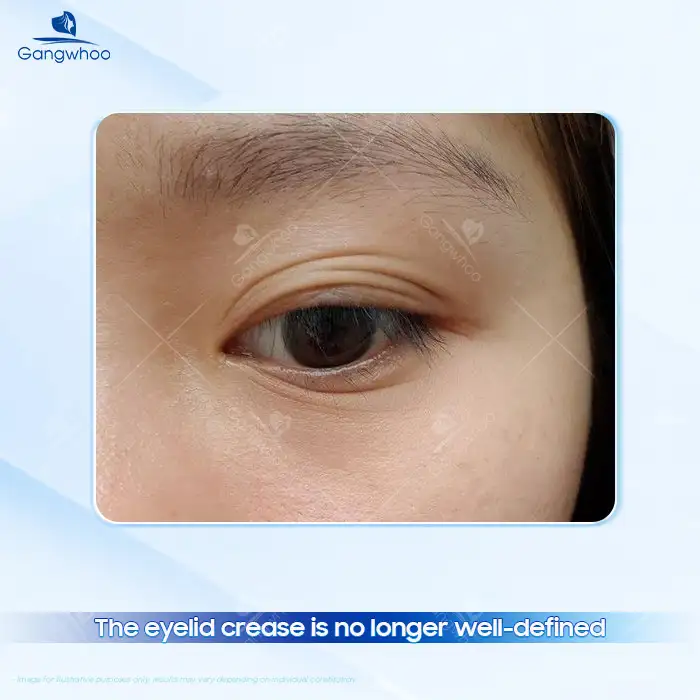
The eyelid crease is no longer clearly defined
The eyelid crease becomes unclear, fades, disappears, or appears lower than normal.
Uneven eyelids, with one side clearly defined and the other drooping.
A heavy sensation in the eyes, difficulty opening them, sometimes the eyelid covers part of the pupil.
Abnormal eye movement, when looking up or blinking the eyelid appears uneven or forms irregular folds.
In severe cases, you may experience true eyelid ptosis, meaning the levator muscle is damaged and no longer has sufficient strength to lift the upper eyelid. At this stage, the condition not only affects aesthetics but may also impact vision, causing blurred sight or eye fatigue during work.
How to Manage Detached Muscle After Double Eyelid Surgery
When noticing signs suggesting detached eyelid muscle after double eyelid surgery, the first thing you should do is visit an eye plastic surgery specialist for an accurate diagnosis. Depending on the severity of the detachment, the doctor will recommend an appropriate treatment plan:
Direct consultation with an eye plastic surgery specialist
Mild cases: If the crease only appears slightly blurred due to swelling or the muscle has not yet stabilized, the doctor may recommend monitoring for another 1–2 months. During this time, the eyelid may recover naturally as scar tissue stabilizes.
True muscle detachment: The doctor will need to perform corrective surgery to reposition the levator muscle and secure it properly. In such cases, the endoscopic microsurgical double eyelid technique combined with the exclusive Plasma scalpel at Gangwhoo Cosmetic Hospital is considered the optimal solution. The Plasma scalpel creates ultra-fine incisions, minimizes invasiveness, reduces tissue trauma, and speeds up recovery, especially effective in complex revision cases or muscle detachment.
The doctor also advises that you should absolutely avoid massaging or applying pressure to the eyelid area, as it may worsen the detachment and make corrective surgery more difficult later.
Doctor’s advice:
If you are experiencing detached eyelid muscle after double eyelid surgery, do not worry too much because it can be effectively corrected with specialized techniques. At Gangwhoo Cosmetic Hospital, a team of experienced eye plastic surgery specialists with many years of expertise in revision eyelid surgery will help restore a natural, balanced, and safe eyelid crease. Especially with the exclusive endoscopic microsurgical Plasma scalpel technology, Gangwhoo is committed to effectively correcting muscle detachment and ensuring natural-looking eyes with faster recovery.