Hello, many customers before deciding on surgery often ask the question: “Does jaw reduction leave long-term complications?”. This is a very legitimate concern, because any intervention related to the jawbone needs to be carefully considered for safety and the long-term nature of the results. The doctor will help you better understand this issue based on medical expertise and practical experience in the field of maxillofacial aesthetic surgery.
Does jaw reduction leave long-term complications?
In principle, jaw reduction is an aesthetic surgery that directly intervenes in the lower mandibular angle bone, aiming to create a slimmer, more balanced facial shape. When performed with the correct technique by an experienced maxillofacial surgeon, jaw reduction does not leave complications or negative long-term effects.
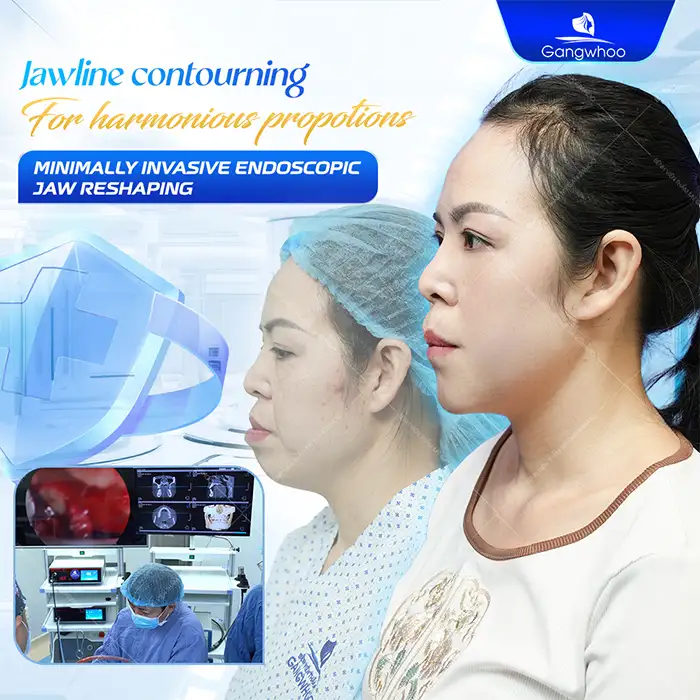
However, the importance lies in the surgeon’s skill and the supporting equipment system. If the surgery is conducted in an environment that does not meet sterile standards, or if the doctor does not master the neurovascular structure of the lower jaw area, the risk of nerve damage, bone infection, or malocclusion can occur, leading to post-jaw reduction complications.
At Gangwhoo Cosmetic Hospital, the entire V-line jaw reduction process is performed using modern 3D endoscopic technology, helping doctors accurately observe the bone structure and nerves, thereby completely eliminating the risk of misplaced invasion. The new generation ultrasonic bone cutting system also helps the operation be gentle, limits bleeding, and minimizes post-operative swelling. As a result, customers can rest assured that jaw reduction at Gangwhoo does not leave complications and ensures absolute safety.
See more: Is jaw reduction painful?
Causes leading to long-term complications and effects
Cases of complications after jaw reduction mostly stem from surgery at non-standard facilities or a lack of strict medical control processes. Some common causes include:

- Invasion of the wrong anatomical position: Cutting the bone too deep or too close to the nerve area can cause numbness in the lips, chin, or long-term loss of sensation.
- No occlusion adjustment: If the jaw angle and bite are not accurately calculated, it can lead to facial asymmetry, and the temporomandibular joint being affected, causing fatigue or pain when chewing.
- Jawbone infection: Due to not ensuring absolute sterility during surgery or improper post-operative care.
- Lack of accurate supporting technology: Manual jaw reduction or not using a 3D positioning system easily leads to deviations in facial proportions.
Notes you need to know before performing jaw reduction
Before undergoing jaw reduction, you need to prepare thoroughly both in terms of physical condition and psychology to ensure the surgery takes place safely:

- General examination and 3D X-ray: Helps the doctor assess the jawbone structure, nerves, and facial proportions to plan the surgery accurately.
- Choose a facility with a maxillofacial surgeon: Should only be performed at a hospital licensed for facial bone surgery, not at spas or small aesthetic facilities.
- Clearly discuss aesthetic desires: Helps the doctor design a suitable jaw shape, avoiding excessive reduction that causes imbalance or changes the natural facial structure.
- Comply with post-operative care instructions: Keep the oral cavity clean, eat soft foods, and limit strenuous jaw movement in the first 1–2 weeks.
See more: How long is the anesthesia for jaw reduction?
The doctor advises that jaw reduction is only safe and does not leave complications when performed at a medical-standard facility, with a sufficient anesthesia and resuscitation system, endoscopic equipment, and a team of experienced doctors. That is also why Gangwhoo Cosmetic Hospital is always chosen by many customers when they want to change their facial structure safely and permanently.


