Upper eyelid surgery followed by excessive tearing – what are the causes? How can it be corrected?
Bao Ngan
Asked: 03/03/2026
My name is Bảo Ngân. I had double eyelid surgery nearly 2 weeks ago. Over the past few days, my eyes have been tearing frequently, especially when exposed to wind or when looking at my phone for a long time. I’m quite worried and unsure whether this is an abnormal sign. Doctor, could you please let me know what causes tearing after eyelid surgery and how it can be treated so it resolves completely?
Hello, I understand your concern when experiencing persistent tearing after eyelid surgery — this often causes anxiety as many people fear it may be a complication. In reality, tearing after double eyelid surgery can occur in some cases, but it is not always dangerous. I will help you clearly understand the causes, severity, and appropriate management so you can feel more reassured.
What causes tearing after double eyelid surgery?
First, I would like to confirm that tearing after double eyelid surgery is a relatively common response during the early postoperative period. There are multiple causes for this condition, which can be divided into physiological causes and causes related to improper surgical technique:
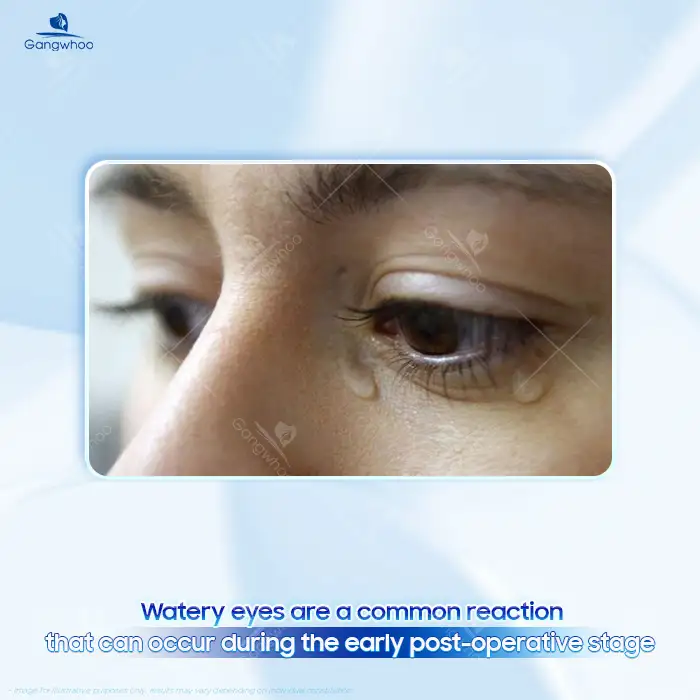
Tearing after eyelid surgery is a reaction that may occur in the early postoperative stage
Physiological cause: After eyelid surgery, the eyelid area often experiences mild swelling and irritation. The body’s natural response is to increase tear secretion to soothe the mucosa and protect the corneal surface from dryness and irritation. This is a normal phenomenon and usually lasts only 3–7 days.
Swelling compressing the lacrimal gland: When the eyelid is swollen or bruised, the lacrimal gland may be stimulated, leading to increased tear production. This condition gradually improves as inflammation and swelling are controlled.
Over-tight suturing or structural misalignment: In some cases, if the surgeon’s technique is not precise — for example, suturing too deeply or deviating from the levator aponeurosis — it may alter the eyelid direction or the lacrimal drainage angle, causing tears to overflow instead of draining into the nasolacrimal duct.
Conjunctival or corneal irritation: If surgical manipulation is not delicate, instruments or sutures may inadvertently irritate the ocular mucosa. In such cases, continuous tearing occurs as a protective reflex.
Therefore, to accurately determine the cause of double eyelid surgery–related tearing, it is necessary to have a specialist examination using microsurgical endoscopy to evaluate scar tissue, the lacrimal gland, and eyelid alignment.
Is tearing after double eyelid surgery considered a complication?
Let me clarify this for you:
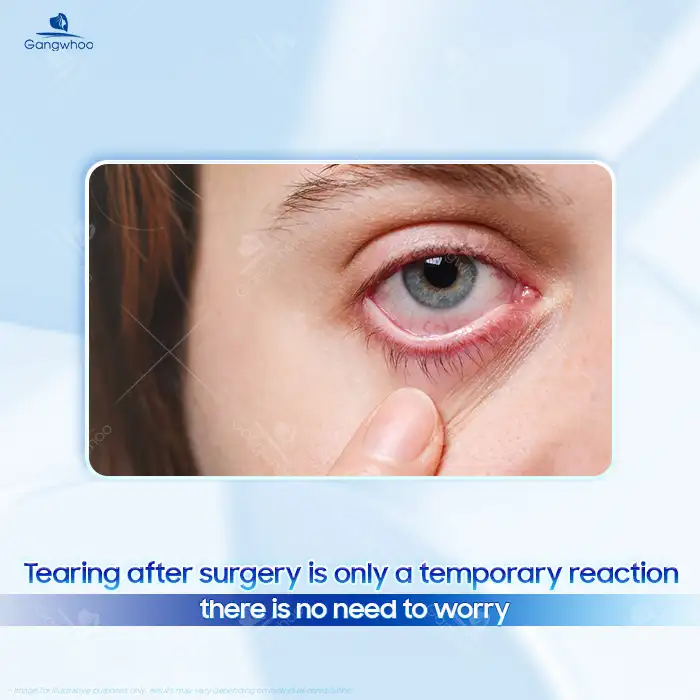
Tearing after eyelid surgery is usually a temporary reaction and not a cause for excessive concern
If tearing after double eyelid surgery lasts only a few days and is accompanied by mild stinging or slight foreign body sensation, then this is merely a temporary reaction, not a complication. Proper hygiene, cold compresses, and medications as prescribed will help the condition resolve quickly.
However, if after 2–3 weeks the eyes continue tearing persistently, with ptosis, asymmetry, or prolonged discomfort, this may indicate a postoperative complication. Common complications include:
Levator muscle misalignment causing traction and deviation at the outer canthus.
Fibrotic scar tissue compressing the lacrimal gland, disrupting normal tear drainage direction.
Excessively deep incision altering upper eyelid structure, resulting in incomplete eyelid closure, ocular dryness, and compensatory hypersecretion of tears.
If not treated promptly, these complications may affect both aesthetic outcomes and eyelid function, so they should not be ignored.
How to manage tearing after double eyelid surgery
Depending on the underlying cause, different treatment protocols will be applied:
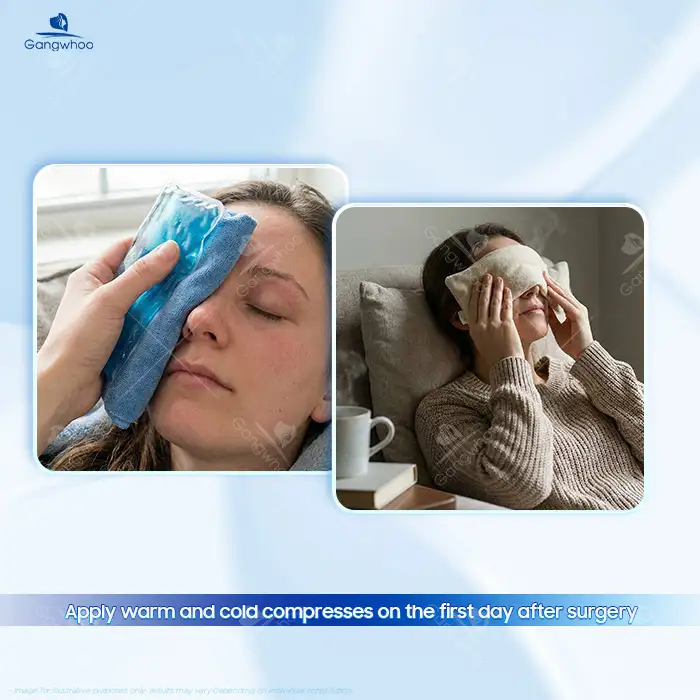
Warm and cold compresses during the early postoperative days
Mild physiological cases: Continue using sterile saline or artificial tears 2–3 times per day to soothe the corneal surface. At the same time, apply cold compresses during the first 48 hours followed by gentle warm compresses to reduce swelling, which will help alleviate tearing.
Cases involving fibrotic scarring or lacrimal compression: A microsurgical corrective procedure may be required to release scar tissue and restore normal lacrimal drainage direction. This surgery should be performed at a facility equipped with a microsurgical endoscopic system and proprietary Plasma device to ensure high precision and avoid damage to healthy tissues.
Cases of eyelid asymmetry or incomplete closure: Require re-evaluation and precise eyelid crease reconstruction, combined with levator muscle restoration. This is a complex technique requiring a surgeon with extensive expertise in oculoplastic surgery.
At Gangwhoo Cosmetic Hospital, our team of Ophthalmology – Aesthetic specialists applies microsurgical endoscopic double eyelid technology combined with a proprietary Plasma device, enabling highly precise manipulation, minimizing trauma to the lacrimal gland, and ensuring natural, soft, and absolutely safe eyelid contours.
In summary, tearing after double eyelid surgery is not necessarily a complication; however, if it persists or is accompanied by discomfort, you should visit an oculoplastic specialist for early evaluation.
If you are currently experiencing this condition, you may visit Gangwhoo Cosmetic Hospital for direct examination and assessment by Korea-trained surgeons using a microsurgical endoscopic system.
Here, the doctors will comprehensively resolve postoperative tearing while reconstructing a natural, balanced, and long-lasting eyelid crease.