What Should I Do If My Chin Implant Is Misaligned? Dr. Phùng Mạnh Cường Explains
Hai Anh
Asked: 14/09/2026
It has been some time since I had a chin implant, but I have noticed that my chin seems slightly shifted to one side, making it look quite asymmetrical from the front. I do not know whether this is because my chin has not yet stabilized or because the implant has shifted out of position. May I ask what I should do if my chin implant is misaligned? In a case like mine, would I need revision surgery or have the implant secured again? If revision is necessary, will it affect the shape of my chin in the future?
Hello! If you have a misaligned chin implant, first of all, you should not worry excessively, and you should not attempt to manually adjust your chin at home. Chin asymmetry after surgery can result from various causes, including uneven swelling during the recovery period and an implant that was placed incorrectly or has become displaced.
In medicine, it is important to distinguish between facial asymmetry, implant malposition, and implant displacement. Complications such as displacement, asymmetry, infection, and bone changes have been documented in studies of chin implants.
Therefore, the answer to the question “what should I do if my chin implant is misaligned?” is: the exact cause must first be identified, and only then can a decision be made on whether to monitor the condition or perform revision surgery.
Does a Misaligned Chin Implant Always Mean That the Implant Has Shifted?
Not every case of a misaligned chin after augmentation is caused by implant displacement
Not every case in which the chin appears misaligned after augmentation means that the implant has shifted.
After surgery, the chin area may develop swelling, bruising, and uneven swelling between the two sides. As a result, the contour of the chin may temporarily appear asymmetrical when viewed from the front. If the surgery was performed recently and the soft tissues are still recovering, the doctor will generally need to assess the progression over time rather than intervene prematurely.
Conversely, if the swelling has subsided but the chin remains noticeably misaligned, or if the chin shape continues to change, possible causes such as implant malposition, an inappropriate implant pocket, implant displacement, or asymmetry of the underlying bone structure should be considered.
Signs That May Indicate Implant Malposition
In some cases, the tip of the chin may be visibly shifted away from the facial midline, the chin contours on both sides may be asymmetrical, or the shape of the chin may differ from its appearance immediately after surgery. Some people may also feel that the implant is mobile or notice an unusual sensation when touching the chin area.
However, visual observation alone is not sufficient to determine whether the implant is actually misaligned. A doctor needs to perform a direct examination and, when necessary, may recommend appropriate diagnostic imaging.
Why Does a Chin Implant Become Misaligned?
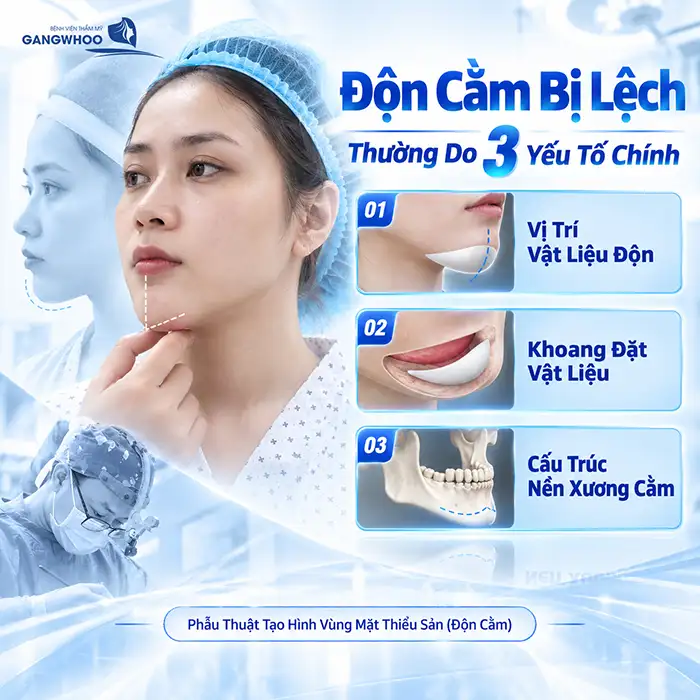
In clinical practice, I usually pay attention to three main factors: the position of the implant, the implant pocket, and the underlying bony structure of the chin.
A misaligned chin implant is usually caused by 3 main factors
1. An Inappropriate Implant Pocket
When the dissection pocket is too wide, created in the wrong anatomical plane, or is not appropriate for the size and shape of the implant, the implant may become unstable. Medical literature on facial implants also notes that asymmetry and displacement may be associated with implant size selection, the extent of dissection, and the method of implant placement.
2. The Implant Is Not Properly Stabilized
Depending on the material, location, and surgical technique, the doctor may consider different fixation methods, such as suture fixation or screw fixation. However, there is no single fixation method that is appropriate for every case; the decision must be based on the patient’s anatomy and actual condition.
3. The Underlying Chin Bone Is Already Asymmetrical
This is a cause that I pay particular attention to during consultation. Some people already have chin deviation, mandibular asymmetry, or an unbalanced maxillofacial relationship before undergoing augmentation. If an implant is used solely to increase projection without assessing the underlying bone structure, the aesthetic result may not achieve the desired balance.
In cases of complex skeletal asymmetry, genioplasty – chin bone contouring surgery may be an option to consider depending on the indication. This technique allows the position and morphology of the chin bone to be adjusted rather than simply changing the external volume with an implant.
What Should I Do If My Chin Implant Is Misaligned?
Do not manually adjust, push, or massage the chin to avoid causing the implant to shift
If you are experiencing this condition, the first thing I recommend is not to manually adjust, push, or massage the chin area forcefully with the intention of moving the implant back to the center. Improper manipulation may damage the soft tissues or alter the implant pocket.
If the chin was recently operated on and the primary cause is swelling, the doctor may provide instructions for postoperative care and monitor the recovery process. As the swelling decreases, the shape of the chin will gradually become clearer.
If the chin has stabilized but remains misaligned, the doctor needs to determine whether the implant has malposition or displacement. When the implant is confirmed to be in the wrong position, treatment options may include revising the pocket, repositioning the implant appropriately, and securing it again when indicated.
A study on revision surgery for complications associated with chin implants showed that cases with complications may require different approaches, such as repositioning and fixation, replacement with a custom-designed implant, or conversion to genioplasty, depending on the cause and anatomical characteristics.
Does Correcting a Misaligned Chin Require Removing the Implant?
Not every case requires implant removal; depending on the specific condition, the doctor will consider the appropriate correction
Not every case requires implant removal.
If the implant remains appropriate in terms of size, shape, and material but is simply malpositioned, the doctor may consider repositioning it and securing it according to the actual condition.
Conversely, if the implant is not suitable for the chin structure, has caused complications, or revision of the existing implant cannot provide a good result, the doctor may consider replacing the implant or choosing another contouring method.
In particular, for people who have undergone multiple chin surgeries, scar tissue and changes to the surgical pocket may make revision surgery more complex. Therefore, the decision to remove or replace an implant should not be made solely based on images or online consultation.
How Can a Misaligned Chin Be Corrected and the Risk of Recurrence Minimized?
In my view, correcting a misaligned chin is not simply a matter of “moving the implant back to the center.” More importantly, it is necessary to identify the cause of the chin misalignment.
Before revision surgery, it is necessary to assess the facial midline, implant position, soft tissues, underlying chin bone, and its relationship with the mandibular contour. Only then can the doctor determine how the implant pocket should be revised.
In appropriate cases, implant fixation may be used to increase implant stability. The fixation methods studied include suturing and screw fixation; however, their effectiveness and indications depend on the specific location, implant type, and surgical technique.
At Gangwhoo Cosmetic Hospital, when performing chin contouring procedures, I focus on controlling the surgical pocket and implant position according to each patient’s anatomical characteristics. In indicated cases, microsurgical suturing techniques and the 4K endoscopic system may be applied to support visualization and precise manipulation within the surgical field.
However, I want to emphasize that technology or any single technique cannot replace professional assessment. Each case of chin asymmetry requires an individualized treatment plan based on the actual cause.
Can a Misaligned Chin Implant Be Corrected?
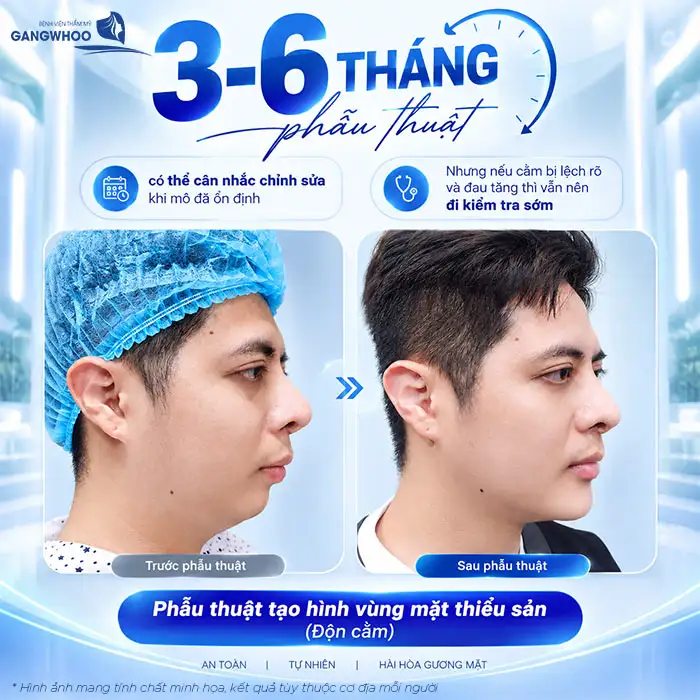
If the tissues in the chin area have stabilized after 3–6 months, revision of the misaligned chin may be considered
In most cases, a misaligned chin implant can be assessed and an appropriate treatment approach can be determined, but the extent of intervention will vary.
If the cause is swelling, monitoring may be all that is needed. If the implant has become displaced, repositioning and fixation may be necessary. If the problem originates from the underlying bone structure, treatment may require deeper intervention involving the chin bone.
The goal of revision surgery is not only to correct the chin asymmetry but also to create harmony between the chin – lips – mandibular contour – overall face. Therefore, I always prioritize anatomical balance rather than trying to create a chin that is extremely long or highly projected.
When Should You See a Doctor?
You should return for an examination promptly if the chin is significantly misaligned or the implant has shifted
If the chin is only slightly misaligned during the early postoperative period, you should follow the postoperative care instructions and attend follow-up appointments as scheduled.
However, if the asymmetry becomes increasingly noticeable, the chin does not improve after the tissues have stabilized, you feel that the implant is mobile, or you develop pain, swelling, redness, warmth, discharge, or other abnormal signs, you should visit a medical facility for evaluation.
In particular, for people who have previously undergone chin augmentation and wish to correct a misaligned chin, I recommend providing complete information about the previous surgery, the type of material used, and when the procedure was performed. These details give the doctor a better basis for assessing the previous surgical pocket and developing a safer revision plan.
Dr. Phùng Mạnh Cường Provides Consultation for Misaligned Chin Revision at Gangwhoo Cosmetic Hospital
If you are worried about what to do if your chin implant is misaligned, do not rush to manually adjust your chin or decide to remove the implant before the cause has been identified.
At Gangwhoo Cosmetic Hospital, Dr. Phùng Mạnh Cường will assess the implant position, degree of asymmetry, soft tissues, and underlying chin structure based on the actual condition before recommending an appropriate treatment approach. For suitable cases, surgery may be supported by 4K endoscopy and microsurgical suturing techniques, with the goal of achieving good control of the surgical field and optimizing precision during the revision procedure.
The most important factors remain the right cause – the right technique – the right indication. When the chin asymmetry is caused by the implant, the implant needs to be addressed; when the problem lies in the underlying bone, the bone structure needs to be assessed. The same method should not be applied to every patient.
If you are experiencing chin asymmetry after augmentation, the safest approach is to undergo a direct examination so that the doctor can accurately determine the cause and recommend an appropriate treatment plan based on your facial structure.