Can failed breast augmentation be corrected? How is it performed?
Nguyen Ngoc Lan
Asked: 29/04/2026
I’ve heard that there are cases where breast augmentation fails, becomes misaligned, or develops capsular contracture. If I happen to encounter such a situation, can it be corrected, doctor? How is the revision process performed, and is it more dangerous than the first surgery?
Hello,the doctor understands that after breast augmentation, one of the biggest concerns for many women is failed breast augmentation — an unwanted complication that can occur if the surgical procedure or postoperative care is not properly managed. This is an issue that needs to be clearly understood in order to handle it promptly and avoid affecting both aesthetics and health. Below are detailed explanations from a professional perspective to help you better understand.
Can failed breast augmentation be corrected?
The answer is yes, failed breast augmentation can be completely corrected, however, the level of intervention and recovery outcome will depend on the cause of the complication as well as how early or late it is detected.
In most cases, the doctor can perform revision surgery (re-augmentation) to address issues such as implant displacement, capsular contracture, shifting implants, or breast deformity. The corrective process includes removing fibrotic tissue, recreating the breast pocket, and placing a new implant with higher biocompatibility, typically using implant lines such as Nano Chip, Ergonomix, or microtextured Arion, which help reduce the risk of recurrent capsular contracture and provide a softer, more natural breast shape.
However, not all cases can be corrected immediately. In cases of infection, necrosis, or implant infection, the doctor must remove the implant and stabilize the breast tissue before performing revision surgery after several months. Therefore, thorough evaluation using 4K endoscopy imaging or soft tissue ultrasound is extremely important to determine the appropriate treatment plan.
At Gangwhoo Cosmetic Hospital, the correction of failed breast augmentation is performed using 4K endoscopic microsurgery, Harmonic scalpel, and Plasma scalpel, ensuring absolute precision, minimal invasiveness, and faster recovery time. As a result, even severe cases can regain a natural, balanced, and safe breast shape.
Causes of failed breast augmentation
The condition of failed breast augmentation can result from various causes, generally categorized into three main groups:
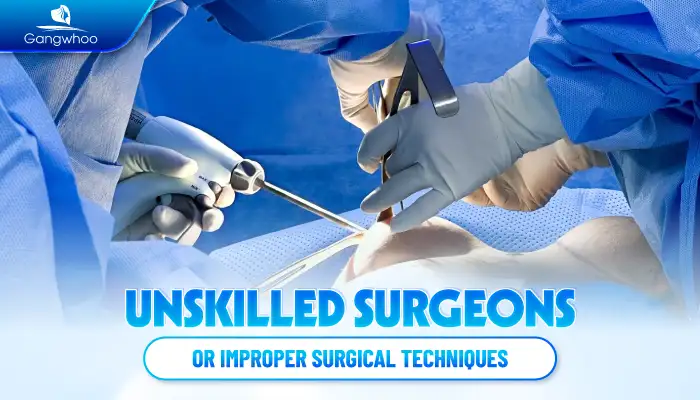
Inadequate surgical skill and technique
Surgeon skill or surgical technique: This is the most critical factor. If the surgeon lacks experience in creating the breast pocket, determining implant placement, or handling surrounding tissue accurately, the risk of implant displacement, capsular contracture, or breast deformity is very high.
Poor-quality implants: Implants of unclear origin, not meeting medical standards, or not suitable for the body are prone to leakage, rupture, or adverse reactions with breast tissue, leading to postoperative complications.
Improper postoperative care: After breast augmentation, if you apply strong pressure, lie prone, do not wear a support bra properly, or fail to attend follow-up appointments, the implants are likely to shift or fibrotic tissue may form abnormally around them.
All these factors can lead to unsatisfactory aesthetic results and may even require revision surgery.
Common signs of failed breast augmentation
Early recognition of signs of failed breast augmentation is extremely important for timely intervention. Below are common symptoms you should pay close attention to:
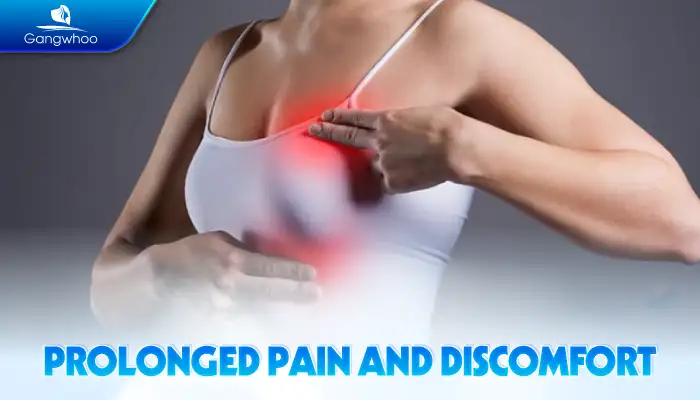
Persistent pain after breast augmentation
Asymmetry or deformity: The breasts are uneven, with implants shifted to one side or positioned at noticeably different heights.
Persistent pain or tightness: Ongoing pain after 2–3 months, with firmness or a tight, constricted sensation around the implant.
Wrinkled, red, or warm skin: This may indicate tissue inflammation or fluid accumulation.
Hardness and loss of elasticity: A typical sign of capsular contracture — a common complication if the implant is not compatible or care is improper.
Leakage or abnormal shape changes: This may result from implant rupture or fibrotic contraction.
If you notice any of these signs, you should visit a reputable aesthetic medical facility immediately for examination, diagnosis, and early treatment to prevent the condition from worsening.
How to handle failed breast augmentation
Depending on the specific condition, the doctor will recommend an appropriate corrective method. For mild cases such as slight implant displacement or grade 1–2 capsular contracture, treatment may involve medication, massage, or minimally invasive endoscopic pocket adjustment.
However, in cases of severe failed breast augmentation (such as grade 3–4 capsular contracture, implant rupture, or breast deformity), the doctor will need to perform comprehensive revision surgery. This process includes:
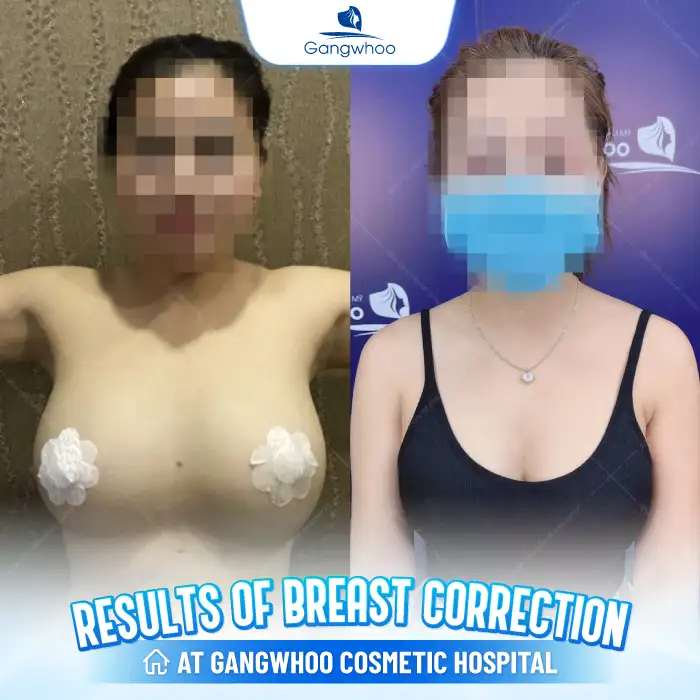
Results of failed breast correction at Gangwhoo Cosmetic Hospital
Removing fibrotic or inflamed tissue surrounding the old implant.
Reconstructing the breast pocket and reshaping the implant placement.
Replacing with a new implant that offers higher compatibility and suits the body structure.
Choosing a surgeon specialized in breast reconstruction along with advanced technologies such as 4K endoscopic microsurgery, Harmonic scalpel, and robotic-assisted arms at Gangwhoo Cosmetic Hospital will ensure high safety, minimize the risk of recurrent capsular contracture, and deliver the most natural results.
Doctor’s recommendation:
If you suspect failed breast augmentation, do not attempt self-treatment or delay medical consultation, as this may worsen tissue damage. You should visit Gangwhoo Cosmetic Hospital for a comprehensive evaluation using 4K endoscopy and specialized breast ultrasound to accurately determine the cause and establish the most appropriate treatment plan.
Gangwhoo is a pioneer in failed breast correction, applying advanced technology with a team of plastic surgeons with over 15 years of experience. As a result, thousands of cases with severe complications have been successfully restored, achieving balanced, soft, and long-lasting safe breast results.