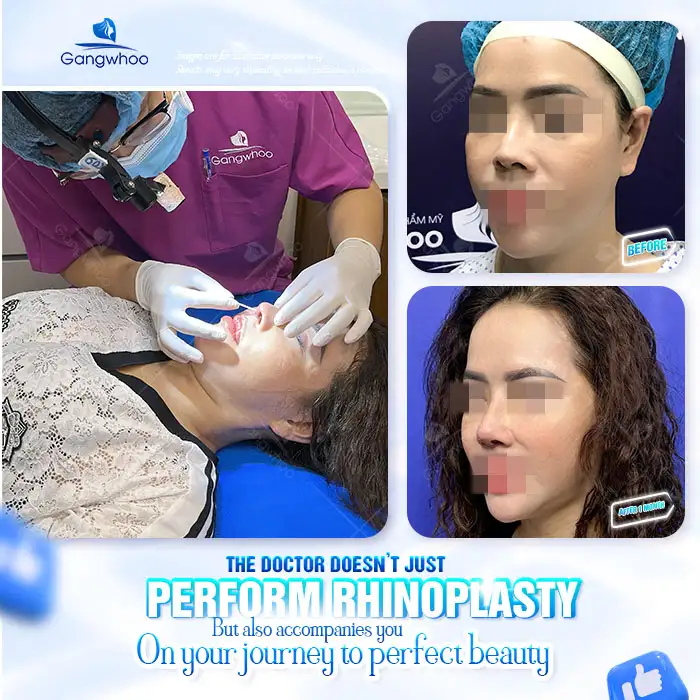
Is secondary rhinoplasty painful? Sharing experience with secondary rhinoplasty
Tuan Anh
Rhinoplasty
Asked: 10/12/2025
I am worried about whether a second rhinoplasty will be more painful than the first one. I hope the doctor can share experiences as well as important things to know when undergoing a second rhinoplasty so that I can prepare myself mentally and physically.
Hello, many clients, after a period of having their first rhinoplasty but not being fully satisfied with the nasal shape, or experiencing complications such as deviation, implant visibility, redness, etc., often wonder whether a second rhinoplasty is painful and whether it is safe. The doctor understands that this is a very valid concern, because revision rhinoplasty is usually more complex than the first procedure. Today, the doctor will explain in detail so that you clearly understand the nature of secondary rhinoplasty, the level of pain involved, the reasons for revision, and the experiences that help ensure a safe surgery with the best possible outcome.
Is a second rhinoplasty painful?
The doctor answers as follows: a second rhinoplasty is not overly painful if it is performed correctly and under proper medical standards. During the revision surgery, you will receive local anesthesia or light general anesthesia, so you will not feel pain during the procedure. After the anesthesia wears off, the nose area may feel slightly swollen, tight, or mildly sore during the first 2–3 days, but this level of discomfort is completely tolerable and will quickly subside with prescribed pain relievers and anti-inflammatory medications.
The biggest difference between the first rhinoplasty and a second revision lies in the condition of the nasal tissues, which have already been previously operated on and may contain fibrotic tissue or internal scarring. Therefore, the surgeon’s expertise and surgical technology play a critically important role in precise dissection and in avoiding damage to the nasal structure.
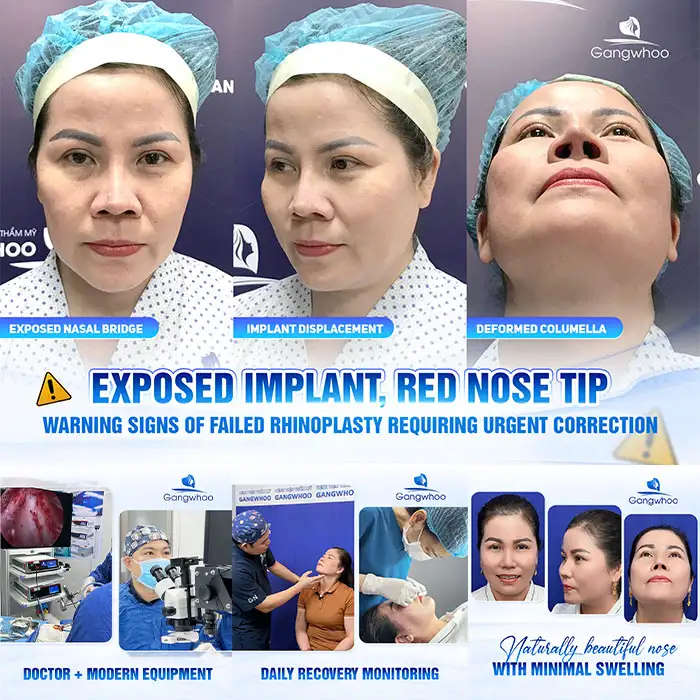
At Gangwhoo Cosmetic Hospital, secondary rhinoplasty procedures are performed using 4K microsurgical endoscopy, which allows the nasal tissue structures to be magnified multiple times. This enables extremely accurate dissection and implant placement, thereby not only minimizing pain and swelling but also significantly reducing the risks of bleeding or recurrent scar tissue formation.
Thus, whether a second rhinoplasty is painful depends mainly on three factors:
The surgeon’s skill and surgical technique.
The condition of the nose after the first rhinoplasty (scar tissue, fibrosis, complications, etc.).
The surgical method and the quality of the implant used (such as Surgiform or Nanoform, which have high biocompatibility and minimize tissue reactions).
Reasons why a second rhinoplasty may be necessary
Doctors usually indicate a second rhinoplasty in the following cases:
Nasal deviation after surgery: caused by incorrect implant placement or implant shifting over time.
Implant visibility or redness: commonly occurring in thin-skinned noses, when low-quality implants are used, or when the nose is raised too high compared to the original nasal foundation.
Tip contracture or implant displacement: complications caused by insufficient tip protection cartilage or strong tissue contracture reactions.
Unbalanced nasal shape: an overly high nose, sharp tip, or an unnaturally straight bridge that makes the face look unnatural.
Nose damage due to infection or surgery at an unreliable facility: these cases require early intervention to prevent further damage to the natural nasal tissues.
Each of the above conditions requires a different corrective approach, such as removing the old implant, reconstructing the nasal tip with autologous cartilage, or rebuilding the nasal bridge using Surgiform to prevent recurring complications. Therefore, choosing a surgeon who specializes in revision and reconstructive rhinoplasty is the key factor for a successful outcome.
Experiences you should know when undergoing a second rhinoplasty
To achieve the desired results with a second rhinoplasty, you should keep in mind the following experiences:
Do not undergo revision too early. Ideally, you should wait at least 6–12 months after the first surgery, when the nasal tissues have fully stabilized. Early intervention significantly increases the risk of tissue damage and recurrent scarring.
Choose a surgeon who specializes in revision rhinoplasty. This is a difficult procedure that requires experience in managing scar tissue and reconstructing the existing nasal structure.
Prioritize safe technologies: 4K microsurgical endoscopy helps reduce pain and bleeding, and Surgiform or Nanoform implants ensure high compatibility and long-term shape stability.
Have the procedure performed at a qualified hospital. Proper facilities, sterile operating rooms, and safe postoperative care protocols help ensure smooth surgery and faster recovery.
Strictly follow postoperative care instructions: take medications as prescribed, avoid nasal impact, maintain proper sleeping posture, and attend follow-up appointments as directed by the doctor.
If you are in a situation where you need a second rhinoplasty, do not worry too much. At Gangwhoo Cosmetic Hospital, nasal specialists with over 15 years of experience will directly examine you, perform CT scans of the nasal structure, and develop a personalized revision plan. By applying 4K microsurgical endoscopy and high-end implants such as Surgiform and Nanoform, Gangwhoo helps clients safely reconstruct the nose with natural, soft results and without leaving scars.
If you would like more detailed consultation about your condition or are still concerned about whether a second rhinoplasty is painful, you can schedule an appointment for a direct examination so the doctor can recommend the most suitable solution for you.
Hello Doctor, I am considering rhinoplasty to improve the shape of my nose because my nose is quite low and the tip is slightly wide, making my overall facial features look less harmonious. However, after researching, I found that there are many cosmetic hospitals and spas advertising rhinoplasty services, so I am quite confused about […]
I’ve heard that nowadays there are Nano breast implants without identification chips, which are different from implants with embedded chips. Doctor, could you explain exactly what Nano implants without chips are, what their advantages and disadvantages are, and whether I should choose this type? I’m a bit concerned about having a “chip” inside my body, […]
Doctor, after my rhinoplasty, I noticed that the tip of my nose feels a bit hard compared to normal, and it feels quite uncomfortable. I don’t know what causes this or whether it is a normal condition or an abnormal sign that requires a medical check-up. If this is a normal condition, what should I […]
I am interested in endoscopic breast augmentation because I’ve heard it is gentler than traditional methods. However, I am still a bit afraid of pain and concerned about risks after surgery. Doctor, could you tell me whether endoscopic breast augmentation is painful, what the procedure involves, and what should be noted after surgery to recover […]
Hello Doctor, I just underwent a rhinoplasty and am very concerned about post-operative care. Could you please advise me on the correct and scientific way to care for my nose after surgery so that it recovers quickly, reduces swelling and pain, and avoids complications? Additionally, I would like to know any important precautions during the […]
I am learning about nasal surgery and have seen many people share that rhinoplasty not only enhances beauty but also helps the face look more refined and boosts confidence. So, doctor, could you please share the practical benefits of rhinoplasty, and whether it is worth considering if my nose is slightly low but still balanced?