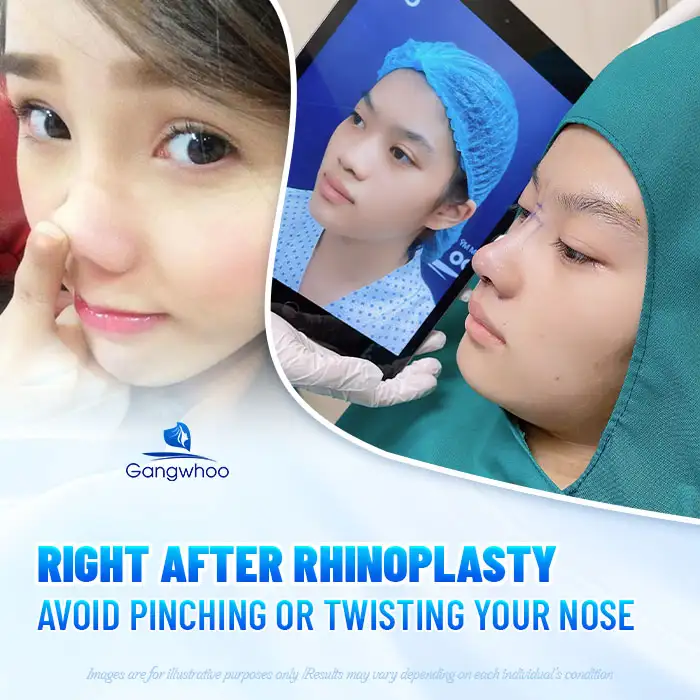
Can you pinch your nose after rhinoplasty? How long before you can twist or manipulate your nose?
Ngoc Thao
Rhinoplasty
Asked: 10/01/2026
I had rhinoplasty one month ago, and now when I touch my nose it feels quite firm, so I don’t dare pinch or gently twist it. How long after rhinoplasty can I pinch my nose to check its softness, and would doing so affect the nasal shape?
Hello, after rhinoplasty, many people worry about whether the nose is still sensitive or prone to shifting, especially with light contact such as pinching, touching, or twisting the nose. This is a very common concern that doctors receive after patients have just undergone rhinoplasty. Today, the doctor will help you clearly understand whether you can pinch your nose after rhinoplasty, when it is safe to touch the nose, and the important care instructions you should remember.
Can you pinch your nose after rhinoplasty?
The doctor explains that after rhinoplasty, you should absolutely not pinch or twist your nose, especially during the first 1–3 months.
The reason is that after surgery, the nose is still in the process of structural stabilization and shape formation. The augmentation materials (synthetic implants or autologous cartilage) need time to firmly integrate with the soft tissue and nasal bones to ensure a stable and secure nasal shape. If you pinch, press, or squeeze your nose too early, the applied force may:
Cause deviation of the columella or nasal bridge, leading to a crooked or asymmetrical nose.
Cause subcutaneous hematoma, increasing swelling and bruising and prolonging the recovery period.
In some cases, even lead to implant exposure or redness at the nasal tip if the skin has not yet healed firmly.
From a medical perspective, the postoperative nasal area is very sensitive because the vascular system, soft tissues, and cartilage all need time to regenerate. Applying mechanical force (such as pinching the nose) can disrupt tissue healing, causing deformation or damage to the internal structure.
Therefore, regarding the question “Can you pinch your nose after rhinoplasty?” or “Is it okay to pinch your nose after rhinoplasty?”, the doctor advises: Absolutely not during the early postoperative period, until the nose is completely stable.
How long after rhinoplasty can you twist or manipulate your nose?
In general, the recovery and full stabilization time after rhinoplasty depends on the surgical method and each individual’s physiology. However, doctors can provide the following average timeline:
During the first 1–2 weeks: The nose is still swollen, and the soft tissues are not stable. You must absolutely not touch, squeeze, or pinch the nose.
After 1 month: The nasal shape begins to take form but is still relatively soft, and the cartilage has not yet firmly adhered to the tissues. Pinching or applying force at this stage may cause deviation of the bridge or deformation of the nasal tip.
After approximately 3 months or more: When the fibrous tissue surrounding the implant has formed and stabilized, you may gently touch the nose or wash your face normally. However, even at this stage, doctors still advise against pinching, squeezing, or twisting the nose as a habit, because over time it may affect the nasal shape.
In addition, for those who undergo structural or semi-structural rhinoplasty, due to deeper intervention and the use of more autologous cartilage, the stabilization period may extend to 4–6 months.
If you feel that your nose has shifted, hurts when touched, or appears abnormally deformed after accidental impact, you should immediately visit a reputable medical facility such as Gangwhoo Cosmetic Hospital for timely examination and treatment by a specialist.
Notes on nasal care after rhinoplasty
To help the nasal shape stabilize quickly, look natural, and minimize risks, the doctor advises you to keep the following important points in mind:
Do not touch, squeeze, pinch, or sleep on your side for at least the first 3–4 weeks after surgery.
Avoid wearing glasses, overly tight masks, or allowing hard objects to contact the nose.
Wash your face gently and avoid applying strong pressure to the central facial area.
Avoid foods that may cause inflammation or scarring such as seafood, beef, and water spinach during the first 2–3 weeks.
Drink enough water and supplement vitamin C and zinc to help nasal tissues recover faster.
Attend follow-up appointments as instructed by the doctor to monitor the recovery process.
Doctor’s advice:
After rhinoplasty, proper postoperative care will help maintain the correct nasal shape and ensure long-lasting results. At Gangwhoo Cosmetic Hospital, nasal specialists accompany patients from the surgical stage through postoperative recovery, closely monitoring healing progress and providing detailed care guidance.
If you are still concerned about whether you can pinch your nose after rhinoplasty or would like your postoperative nasal shape checked, you can visit Gangwhoo Cosmetic Hospital to receive free consultation and examination from the medical team.
Hello Doctor, I am considering rhinoplasty to improve the shape of my nose because my nose is quite low and the tip is slightly wide, making my overall facial features look less harmonious. However, after researching, I found that there are many cosmetic hospitals and spas advertising rhinoplasty services, so I am quite confused about […]
I’ve heard that nowadays there are Nano breast implants without identification chips, which are different from implants with embedded chips. Doctor, could you explain exactly what Nano implants without chips are, what their advantages and disadvantages are, and whether I should choose this type? I’m a bit concerned about having a “chip” inside my body, […]
Doctor, after my rhinoplasty, I noticed that the tip of my nose feels a bit hard compared to normal, and it feels quite uncomfortable. I don’t know what causes this or whether it is a normal condition or an abnormal sign that requires a medical check-up. If this is a normal condition, what should I […]
I am interested in endoscopic breast augmentation because I’ve heard it is gentler than traditional methods. However, I am still a bit afraid of pain and concerned about risks after surgery. Doctor, could you tell me whether endoscopic breast augmentation is painful, what the procedure involves, and what should be noted after surgery to recover […]
Hello Doctor, I just underwent a rhinoplasty and am very concerned about post-operative care. Could you please advise me on the correct and scientific way to care for my nose after surgery so that it recovers quickly, reduces swelling and pain, and avoids complications? Additionally, I would like to know any important precautions during the […]
I am learning about nasal surgery and have seen many people share that rhinoplasty not only enhances beauty but also helps the face look more refined and boosts confidence. So, doctor, could you please share the practical benefits of rhinoplasty, and whether it is worth considering if my nose is slightly low but still balanced?