Hello, many patients after rhinoplasty often worry about whether implant displacement may occur and, if so, how long it might take. This is a completely valid concern because implant displacement is one of the most serious complications of rhinoplasty, affecting both aesthetics and health. The doctor will provide a detailed explanation of how long after rhinoplasty implant displacement may occur so that you can feel more at ease.
How Long After Rhinoplasty Can Implant Displacement Occur?
In reality, there is no absolute number for the question “how long after rhinoplasty does implant displacement occur” or “after how many years does the implant slip,” as this depends on many factors: the type of implant material used, the surgeon’s skill, individual biological characteristics, nasal skin thickness, as well as postoperative care.

However, in general, if the surgery is performed with proper technique, high-quality implants are used, and the body is compatible, the nasal shape can remain stable for a long time without implant displacement. Conversely, if rhinoplasty is performed at an unreliable facility, with substandard implant materials, or if the nasal bridge is placed too high relative to the nasal foundation, the risk of implant displacement may appear early, within just a few months to 1–2 years.
Signs of Implant Displacement to Watch For
For early detection, you should pay attention to some characteristic signs of implant displacement after rhinoplasty:
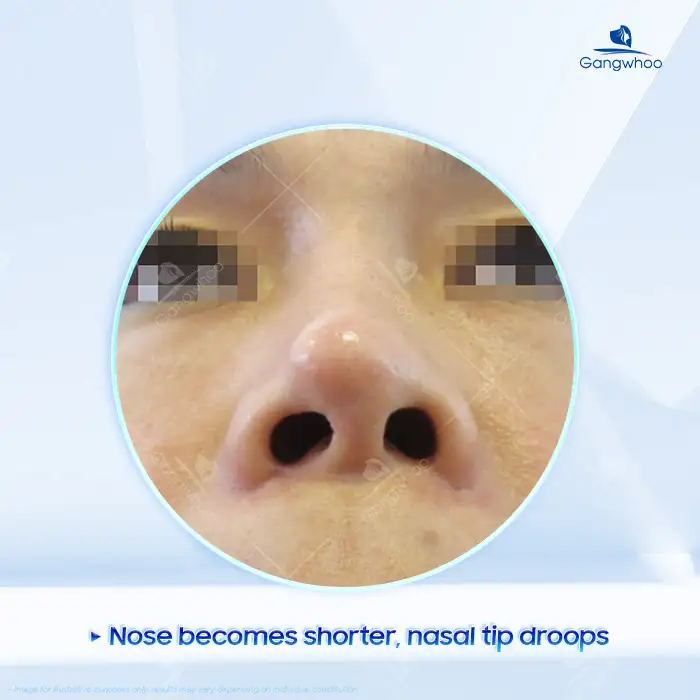
- The nasal tip becomes shiny and red, with abnormally thin and tense skin.
- The nasal bridge feels uneven, deviated, or the implant becomes visible.
- The nose gradually tends to shorten, with the nasal tip drooping downward.
- In severe cases, the implant may push outward, causing perforation of the nasal tip skin.
If one or more of these signs appear, you should not be complacent and need to seek medical examination immediately to avoid more serious complications.
Management of Nasal Implant Displacement
Once implant displacement has occurred, the only treatment is revision surgery to remove the damaged implant and reconstruct a new nasal structure. Doctors usually use autologous cartilage (septal cartilage, ear cartilage, or rib cartilage) for replacement, combined with supportive materials to reinforce the nasal tip. You should absolutely not attempt self-treatment at home or delay too long, because implant perforation through the skin can lead to infection, necrosis, and make subsequent reconstruction much more complicated.
How to Prevent Nasal Implant Displacement
To minimize the risk of implant displacement, you should keep the following in mind:

- Choose a surgeon with high professional expertise and extensive experience in structural rhinoplasty.
- Use only safe implant materials with clear origins.
- Avoid raising the nose too high or excessively tight relative to the skin structure and nasal foundation.
- Strictly follow postoperative care instructions and attend regular follow-up visits.
In summary, the answer to the question “how long after rhinoplasty does implant displacement occur” varies from case to case, but you can significantly reduce this risk by choosing the right surgeon, the appropriate method, and providing careful postoperative care. If you are worried about the condition of your nose or would like advice on safe solutions, please visit Gangwhoo Cosmetic Hospital for examination and the most appropriate treatment plan.


