Is it harmful to eat spicy food after rhinoplasty? Should spicy seasonings be used?
Thanh Ha
Rhinoplasty
Asked: 02/02/2026
I really enjoy spicy food, but I had rhinoplasty just one week ago. Many people say that spicy food should be completely avoided, but I’m not sure if that’s true. So is it harmful to eat spicy food after rhinoplasty, and if it is allowed, what level would be considered safe?
Hello, after undergoing rhinoplasty surgery, postoperative care and diet play a very important role in the recovery process. One of the most frequently asked questions doctors receive is “is it harmful to eat spicy food after rhinoplasty?” or “why do doctors advise avoiding spicy food after rhinoplasty?”. This is a very common concern, as many people have a daily habit of eating spicy food. The doctor will explain in detail so that you can clearly understand the effects of spicy food on postoperative wounds.
Is it harmful to eat spicy food after rhinoplasty?
The answer is yes, eating spicy food after rhinoplasty can negatively affect the recovery process and aesthetic results. From a medical perspective, after rhinoplasty surgery, the soft tissues, blood vessels, and epidermal cells are in the process of regeneration. Eating spicy food can trigger adverse physiological reactions such as:
Eating spicy food after rhinoplasty can negatively affect the recovery process
Increased vasodilation and swelling: Chili, pepper, satay, and other spicy seasonings contain capsaicin – an active compound that stimulates vasodilation. When you eat spicy food, more blood is directed to the facial area, especially the nose, causing redness, burning sensations, swelling, and prolonged recovery time.
Runny nose and sneezing: Spicy flavors stimulate the nasal mucosa, making you more prone to sneezing and nasal discharge. These actions may seem harmless but can create pressure on newly operated tissues, affecting the structure of the newly shaped nose.
Increased risk of infection: After rhinoplasty, open wounds that experience frequent discharge or irritation are more susceptible to inflammation. Spicy food increases nasal secretion, creating a moist environment favorable for bacterial growth.
Impact on scarring: Some studies indicate that capsaicin may disrupt collagen synthesis, leading to delayed wound healing and a higher likelihood of red or dark scars.
Therefore, the answer to the question “is it harmful to eat spicy food after rhinoplasty” is yes – and doctors advise completely avoiding spicy food during the early stage to prevent complications such as prolonged swelling, infection, or nasal bridge deviation.
How long should spicy food be avoided after rhinoplasty?
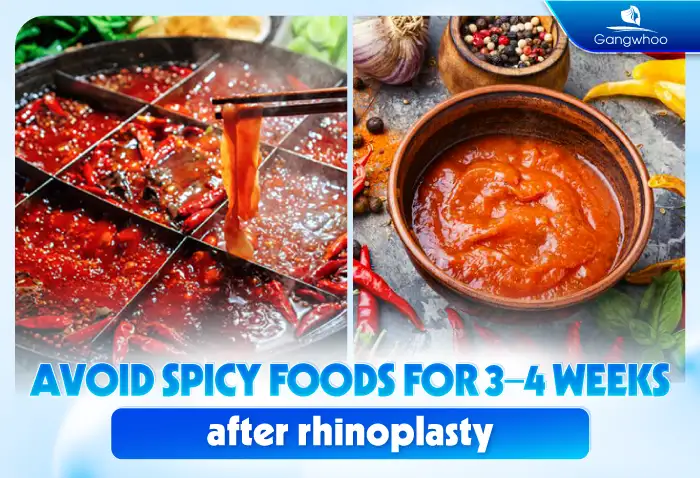
In general, doctors recommend that you avoid spicy food for at least 3–4 weeks after rhinoplasty surgery. This is the necessary period for:
Avoid spicy food for 3–4 weeks after rhinoplasty surgery
Wound closure and cartilage stabilization: In the early stage, the nose is still fragile, and the skin and tissues have not firmly adhered to the cartilage. Eating spicy food may trigger sneezing or inflammation, which can cause cartilage displacement and affect the nasal shape.
Reduced risk of infection: After 3–4 weeks, the soft tissues have closed and recovery becomes more stable, making it safer to gradually reintroduce spicy food in moderation.
However, for structural rhinoplasty, costal cartilage rhinoplasty, or complex revision procedures, doctors usually advise extending the avoidance of spicy food to 6–8 weeks. This is because these procedures involve deeper tissue intervention and require longer healing time.
If you notice that the nasal area is still swollen, red, or feels tight, you should not eat spicy food even after one month. It is best to return to Gangwhoo Cosmetic Hospital for a follow-up examination so that the doctor can assess tissue recovery before you change your diet.
Besides spicy food, what else should be avoided after rhinoplasty?
In addition to avoiding spicy food after rhinoplasty, to ensure faster healing and a well-defined nasal shape, you should also avoid the following food groups:
Other food groups you should remember to avoid
Sticky rice products, seafood, chicken, eggs: These foods may cause itching and increase the risk of hypertrophic or dark scars.
Greasy foods: They slow down cell regeneration and delay wound drying.
Stimulants: Alcohol and tobacco reduce blood circulation and hinder new tissue formation.
Extremely hot or cold foods: Both can cause sudden vasodilation or vasoconstriction, affecting the surgical area.
During this period, you should prioritize easily digestible foods rich in vitamins C, E, and protein such as green vegetables, salmon, boiled eggs, lean meat, and drink plenty of water to support faster tissue regeneration.
Thus, the doctor has clearly explained whether eating spicy food after rhinoplasty is harmful and why spicy food should be avoided after rhinoplasty. In summary, although eating spicy food may seem minor, it can significantly affect aesthetic results if you are careless. To ensure a smooth recovery and stable nasal shape, you should strictly follow dietary restrictions as instructed by your doctor.
At Gangwhoo Cosmetic Hospital, the team of rhinoplasty specialists will provide detailed guidance on postoperative care and diet to minimize complications. If you still have concerns or experience unusual swelling or redness after accidentally eating spicy food, you may visit Gangwhoo for examination and timely management nh
Hello Doctor, I am considering rhinoplasty to improve the shape of my nose because my nose is quite low and the tip is slightly wide, making my overall facial features look less harmonious. However, after researching, I found that there are many cosmetic hospitals and spas advertising rhinoplasty services, so I am quite confused about […]
I’ve heard that nowadays there are Nano breast implants without identification chips, which are different from implants with embedded chips. Doctor, could you explain exactly what Nano implants without chips are, what their advantages and disadvantages are, and whether I should choose this type? I’m a bit concerned about having a “chip” inside my body, […]
Doctor, after my rhinoplasty, I noticed that the tip of my nose feels a bit hard compared to normal, and it feels quite uncomfortable. I don’t know what causes this or whether it is a normal condition or an abnormal sign that requires a medical check-up. If this is a normal condition, what should I […]
I am interested in endoscopic breast augmentation because I’ve heard it is gentler than traditional methods. However, I am still a bit afraid of pain and concerned about risks after surgery. Doctor, could you tell me whether endoscopic breast augmentation is painful, what the procedure involves, and what should be noted after surgery to recover […]
Hello Doctor, I just underwent a rhinoplasty and am very concerned about post-operative care. Could you please advise me on the correct and scientific way to care for my nose after surgery so that it recovers quickly, reduces swelling and pain, and avoids complications? Additionally, I would like to know any important precautions during the […]
I am learning about nasal surgery and have seen many people share that rhinoplasty not only enhances beauty but also helps the face look more refined and boosts confidence. So, doctor, could you please share the practical benefits of rhinoplasty, and whether it is worth considering if my nose is slightly low but still balanced?